
How long should you study for the ACT?
A realistic timeline for ACT prep — how many months, how many hours a week, and how many full-length tests — scaled to the gap between where you are now and your target Composite.
Most students study for the ACT over 2–3 months at about 3–6 hours a week, scaled to the gap to your target Composite: a couple of points might take a month, a larger jump three months or more. Plan to sit 4–6 full-length timed tests along the way, and make pace a priority — the ACT is a speed test, so practicing under real timing matters as much as reviewing content.
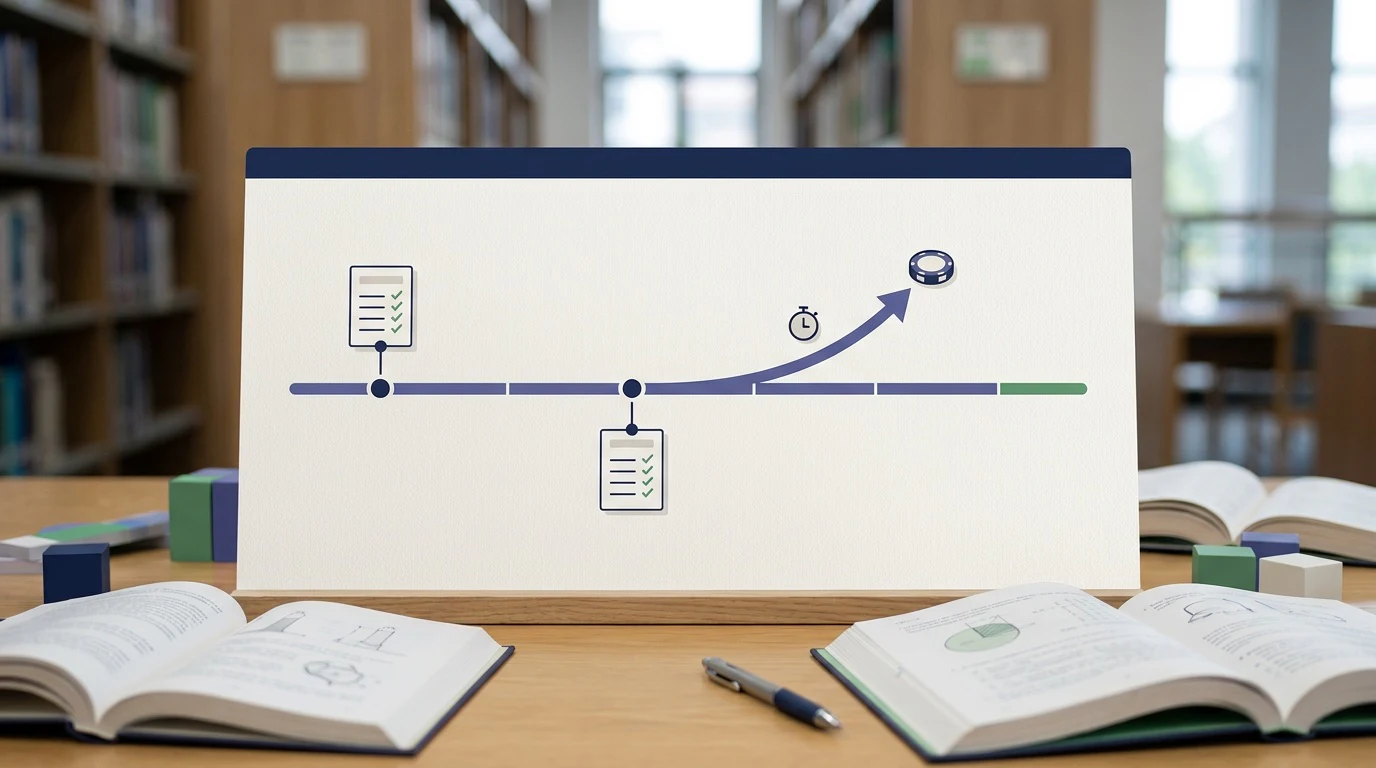
Your timeline depends on the points you need
There's no universal number of hours. The honest answer is to size your prep to the distance between your current Composite and your target — then spread it across enough weeks for the gains to stick.
| Gap to target Composite | Suggested window | Weekly time |
|---|---|---|
| 1–2 points | ~1–2 months | ~3–4 hrs |
| 3–4 points | ~2–3 months | ~4–5 hrs |
| 5+ points | ~3 months or more | ~5–6 hrs |
| Maintaining a strong score | ~3–4 weeks | ~2–3 hrs |
Three things that make study time count
How you study matters more than the raw hours. These three habits move a Composite faster than passive review.
Sit 4–6 under real timing.
Nothing builds ACT readiness like complete, timed tests. They train stamina across English, Math, Reading and the optional Science section, expose pacing leaks, and turn into a mistake list you can actually work through. Space them every week or two.
Practice the clock, not just the content.
The ACT gives you limited time per question, so speed is a trained skill. Time your sections from the start, learn your per-passage and per-problem rhythm, and rehearse when to skip and return. Always bubble every answer — there's no wrong-answer penalty.
Fix the misses that repeat.
After each test, sort errors by type and section, then drill the patterns that cost you the most. A few focused fixes — a recurring grammar rule, a math topic, a reading habit — lift your Composite more than re-reading everything.
Find your starting point first.
Answer a few real-format ACT questions and get a practice estimate — a range, not an official prediction — so you can size the gap to your target.
Back-plan from your test date
Start by picking a test date, then count backward. Reserve the final week or two for full-length tests and light review rather than new material. In the middle weeks, alternate topic practice with timed sections so accuracy and pace grow together. Early on, take one full-length test to set a baseline and reveal your weakest section. Because the ACT is linear, a hard stretch on test day doesn't mean the test changed — steady pacing is what carries you through.
A simple weekly rhythm
- One timed section or two each week to build pace.
- Focused practice on your weakest topics, by section.
- A full-length timed test roughly every week or two.
- A short review session to clear your most common mistakes.
ACT study-time questions
How long should you study for the ACT?
How many hours a week should I study for the ACT?
Can I study for the ACT in one month?
How many practice tests should I take for the ACT?
Is the ACT a speed test?
Keep planning your ACT prep.
Know the timeline. Now start the clock.
Start free, answer a few real-format ACT questions, and get a practice estimate toward your target Composite.
Sources