
AP Chemistry
What the AP Chemistry exam covers, how it's scored, the nine units it's built on, and how to practice your way to a 5.
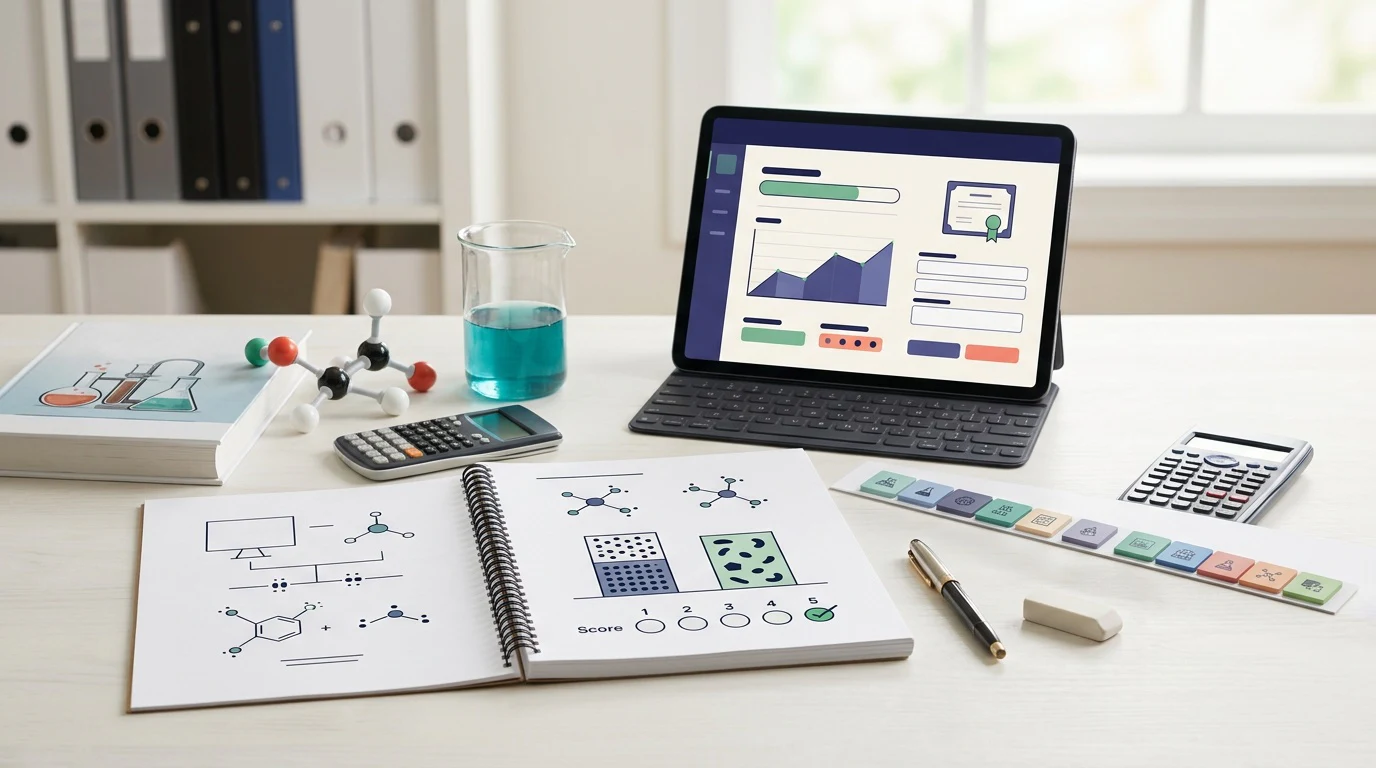
AP Chemistry is a college-level introductory chemistry course and exam covering nine units, from atomic structure and bonding to kinetics, thermodynamics, equilibrium and acids and bases. The exam runs 3 hours and 15 minutes: a 60-question multiple-choice section and a 7-question free-response section, scored from 1 to 5. It's taken in May, and many colleges grant credit for a 3 or higher — confirm your target college's policy.
Two sections, nine units
The exam splits evenly between multiple choice and free response, and questions are drawn from the nine units of the course. A calculator, periodic table and formula sheet are provided throughout.
60 questions, 90 minutes.
Discrete questions and sets tied to data, models and lab scenarios — worth half your score. Reasoning about particles, energy and reactions matters as much as recall, and many items lean on graphs and tables.
7 questions, 105 minutes.
Three long-form and four short-form questions that reward multi-step calculation, clear chemical reasoning and experimental design — the other half of your score. A calculator and periodic table are allowed here.
One 1–5 score.
The two sections combine into a single 1–5. A 3 is "qualified"; a 4 or 5 is strong. Credit policies are set by each college — confirm yours.
Practice it, unit by unit.
Reading about chemistry isn't the same as working AP-style problems and learning from every miss. Start free and practice by unit.
What AP Chemistry covers
- Unit 1 — Atomic Structure and Properties
- Unit 2 — Compound Structure and Properties (Bonding)
- Unit 3 — Properties of Substances and Mixtures
- Unit 4 — Chemical Reactions
- Unit 5 — Kinetics
- Unit 6 — Thermodynamics
- Unit 7 — Equilibrium
- Unit 8 — Acids and Bases
- Unit 9 — Applications of Thermodynamics
How to study for AP Chemistry
- Practice one unit at a time, then mix units like the exam does.
- Drill the free-response — especially multi-step calculations and lab design.
- Master the math: moles, stoichiometry, equilibrium and thermodynamics.
- Review every miss until the concept, not just the answer, is clear.
- Sit timed sets to build pace across both sections.
AP Chemistry questions
What's on the AP Chemistry exam?
How is AP Chemistry scored?
What is a good AP Chemistry score?
How hard is AP Chemistry?
When is the AP Chemistry exam?
Keep exploring AP.
One plan for your whole testing season.
PrepScore’s full practice covers the SAT, the ACT and select AP subjects — with an explanation on every question.