
Population and culture
For AP Human Geography practice, explain migration, demographic change, cultural diffusion and the spatial patterns they create. The first review step names the evidence in the prompt before judging the answer.
Open the unit you need, answer AP-style multiple-choice questions, and review a complete explanation built around maps, spatial patterns and geographic models.
The practice workflow for AP Human Geography has one specific job: Choose one of the 7 units, answer a focused set, and open the explanation for the correct option and every distractor.
7 units · 60 MCQ + 3 FRQ · Practice built around maps, spatial patterns and geographic models
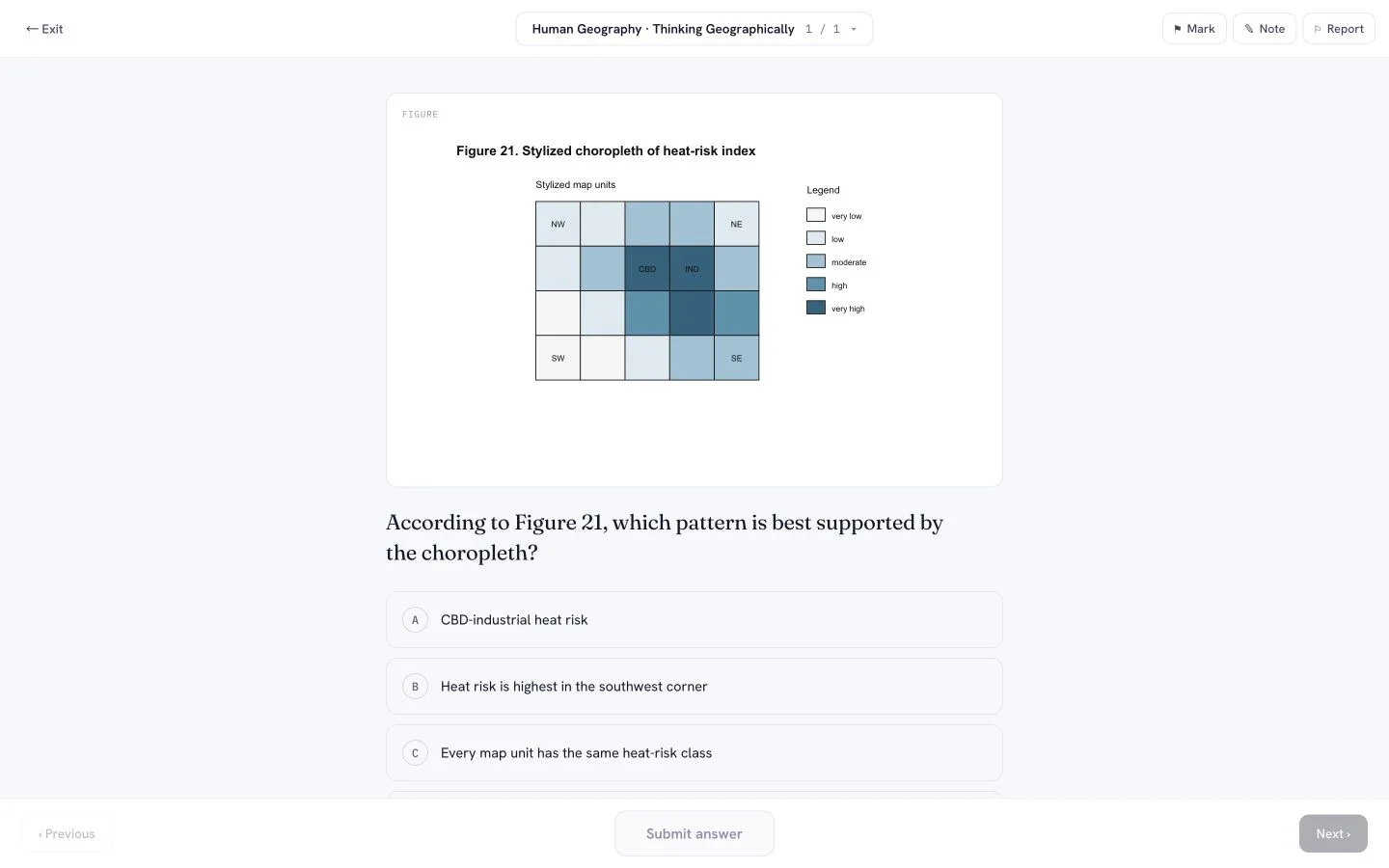
AP Human Geography practice is most useful when it identifies the exact unit and reasoning move behind a miss. Each set stays focused enough to diagnose a gap, then gives you the explanation needed to correct it before the next question.
Focused sets follow the 7 units of AP Human Geography. The content changes by unit, but every question asks you to make the same exam-day move: read the evidence, choose a defensible answer and explain why the alternatives fail.
The focused set should reveal whether the miss came from content, stimulus reading or an answer-choice trap. The evidence remains tied to maps, spatial patterns and geographic models, so the report answers a subject question rather than displaying a generic completion score.
Fact basisCollege Board's current AP Human Geography course and exam description defines the 7 units and 60 MCQ + 3 FRQ structure used on this page. PrepScore applies that published framework to practice and should revise the page when the official blueprint changes.
Keep the practice workflow familiar after AP Human Geography, while each linked course changes the content, scoring task and official exam structure.
Use the AP Human Geography study loop to connect practice with focused questions, written responses, full exams and the specific mistakes that still need work.
Continue with AP