
AP Physics C: Electricity & Magnetism
What the calculus-based AP Physics C: Electricity & Magnetism exam covers, how the current format works, how it's scored, and how to practice your way to a 5.
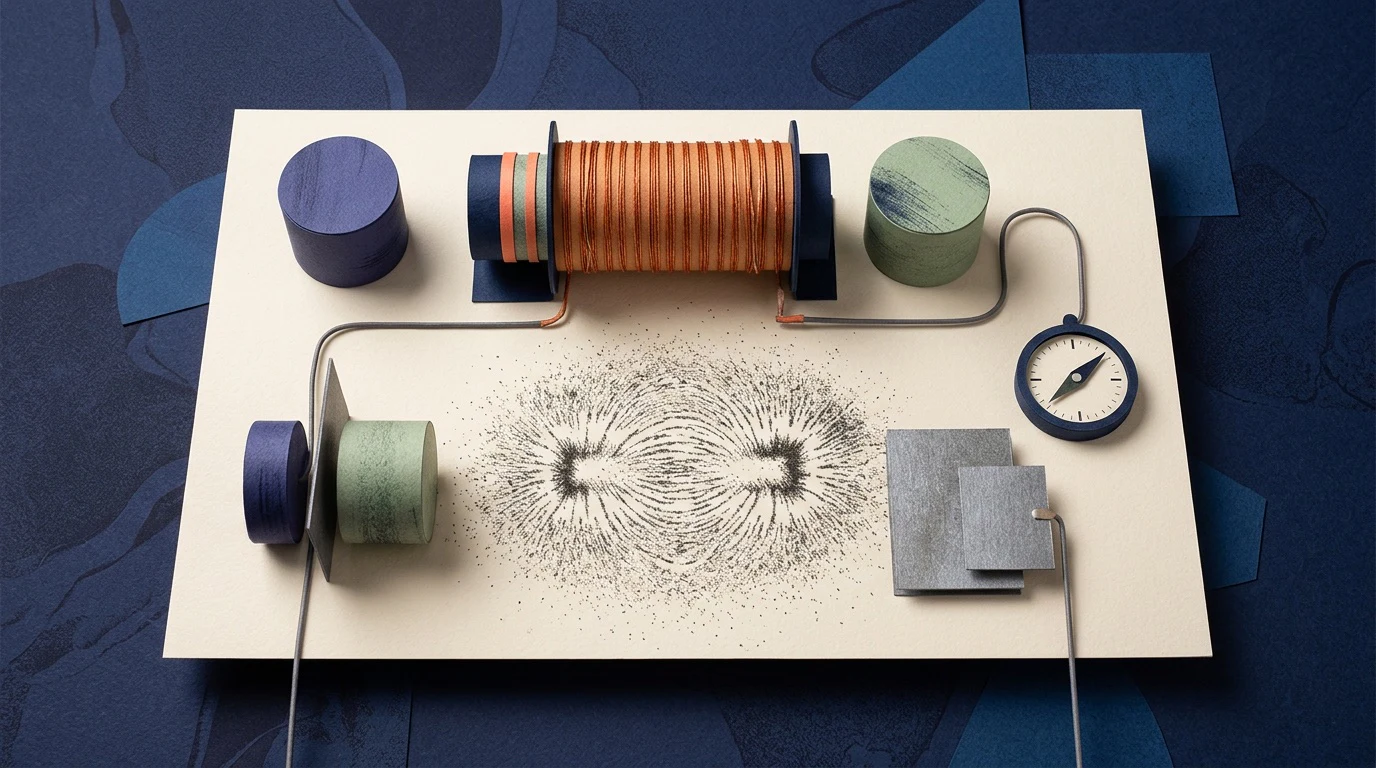
AP Physics C: Electricity & Magnetism is a calculus-based, college-level course and exam on electric and magnetic fields — electrostatics, conductors and capacitors, circuits, magnetic fields and electromagnetism. Under the current format the exam runs about 1 hour 45 minutes with roughly 40 multiple-choice questions and 4 free-response questions, scored from 1 to 5. Calculus is used throughout, a calculator is allowed and a formula sheet is provided. It's taken in May, and many colleges grant credit for a 3 or higher — confirm your target college's policy.
Two sections, one calculus-based E&M course
The College Board expanded each Physics C exam in the current format. The exam now runs about 1 hour 45 minutes across two roughly equal sections — confirm the current numbers on College Board.
About 40 questions.
Single-select questions, many tied to field diagrams, circuit schematics and short scenarios. They reward reasoning about fields and current — ranking field strength or reading a circuit matters as much as recall.
About 4 questions.
Multi-part problems that reward setting up integrals, applying Gauss's and Ampère's laws, analyzing RC circuits and induction, and explaining your reasoning. Partial credit comes from a clear method, not just a final number.
One 1–5 score.
The two sections combine into a single 1–5, weighted roughly equally. A 3 is "qualified"; a 4 or 5 is strong. Credit policies are set by each college — confirm yours.
Practice it, topic by topic.
Reading about fields and circuits isn't the same as working AP-style problems with calculus and learning from every miss. Start free and practice by topic.
What AP Physics C: E&M covers
- Electrostatics — Coulomb's law, electric field and potential, Gauss's law
- Conductors, capacitors and dielectrics — capacitance and stored energy
- Electric circuits — current, resistance, RC circuits and Kirchhoff's rules
- Magnetic fields — forces on charges and currents, the Biot–Savart law and Ampère's law
- Electromagnetism — Faraday's law, induced EMF, inductance and LR circuits
How to study for AP Physics C: E&M
- Build on your Mechanics calculus — add line and surface integrals for Gauss's and Ampère's laws.
- Master symmetry arguments; choosing the right Gaussian or Amperian surface is half the battle.
- Practice one topic at a time, then mix topics the way the exam does.
- Work the free-response by hand — show setups, units and clear field or circuit diagrams for partial credit.
- Review every miss until the physics, not just the answer, is clear, and sit timed sets to build pace.
What makes AP Physics C: Electricity and Magnetism different
Physics C: Electricity and Magnetism is calculus-based field physics. The exam rewards choosing the right law and symmetry before doing the math.
| Area | What matters | Practice move |
|---|---|---|
| Fields | Symmetry first | Use Gauss's law, electric potential and field relationships only after identifying the charge geometry. |
| Magnetism | Direction and circulation | Practice right-hand rules, Ampere's law and forces on moving charges or current-carrying wires. |
| Circuits | Time dependence | Separate steady DC circuits from RC, RL or LC behavior where exponential change matters. |
| FRQ work | Integral reasoning | Write the physical law, choose the surface/path and explain why terms vanish or remain. |
AP Physics C: Electricity & Magnetism questions
What's on the AP Physics C: Electricity & Magnetism exam?
How is AP Physics C: Electricity & Magnetism scored?
What is a good AP Physics C: Electricity & Magnetism score?
How hard is AP Physics C: Electricity & Magnetism?
When is the AP Physics C: Electricity & Magnetism exam?
Keep exploring AP.
One plan for your whole testing season.
PrepScore’s full practice covers the SAT, the ACT and select AP subjects — with an explanation on every question.