
AP Drawing
What AP Drawing asks for, how the portfolio is scored, the two parts it's built on, and how to build a body of work that earns a 5.
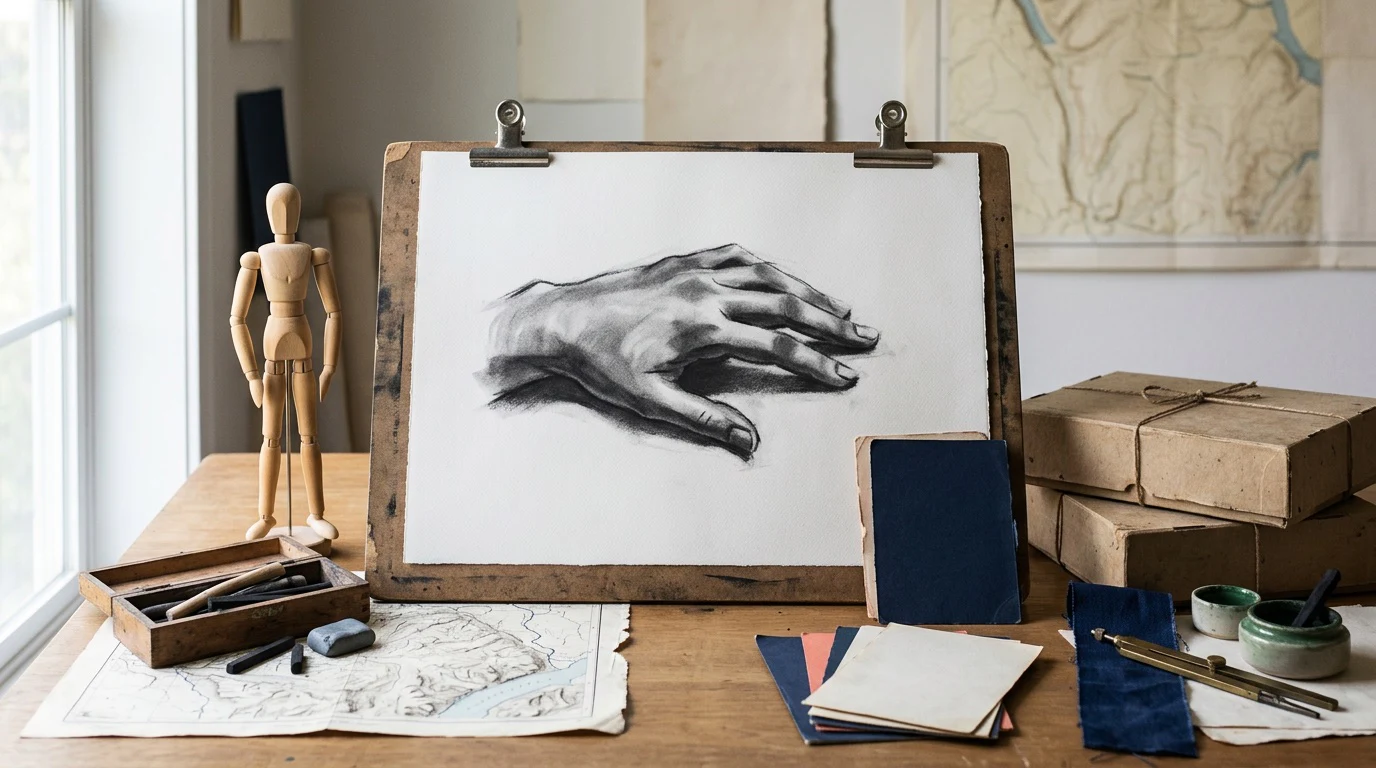
AP Drawing is a portfolio assessment, not a written exam — there is no multiple-choice or free-response section and no test length. Instead you build and submit a portfolio in early May with two parts: a Sustained Investigation (a body of work showing inquiry and development, around 15 images) and Selected Works (about 5 works showing skill), focused on drawing and mark-making. Trained readers score it from 1 to 5, and many colleges grant credit for a 3 or higher — confirm your target college's policy.
Two portfolio parts, one score
Unlike most AP courses, AP Drawing has no sit-down exam. Your 1–5 comes from a portfolio you develop across the year — built around drawing and mark-making — in two parts.
~15 images of inquiry & growth.
A connected body of work driven by your own question or idea. Readers look for genuine inquiry, experimentation, practice and revision over time — visual evidence that your work developed, plus brief written responses explaining what you investigated and how it evolved.
~5 works showing skill.
Your strongest individual pieces, chosen to demonstrate skill with drawing and mark-making — line, shape, value, surface and composition. Each comes with short written information about the materials, processes and ideas behind it.
One 1–5 score.
Trained readers evaluate both parts against published rubrics and combine them into a single 1–5 — no written exam is averaged in. A 3 is "qualified"; a 4 or 5 is strong. Distributions are approximate and vary by year — confirm on College Board. Credit policies are set by each college; confirm yours.
Build the habit, not just the deadline.
A strong portfolio comes from steady making and documenting all year. Start free and use practice to sharpen the skills your best works depend on.
What AP Drawing asks for
- Sustained Investigation — a body of work (~15 images) driven by inquiry
- Evidence of practice, experimentation and revision over time
- Written responses explaining your investigation and how it developed
- Selected Works — about 5 works that best show skill
- A clear focus on drawing and mark-making: line, value, surface, composition
How to build your portfolio
- Choose a real question or idea early and let it drive a series of works.
- Make work consistently — schedule studio time so the body of work grows steadily.
- Document process: photograph stages, experiments and revisions as you go.
- Drill core drawing skills — line, value, perspective and mark-making — so your Selected Works are strong.
- Write clear, specific responses, and back up your images with good photographs before the May deadline.
What makes the Drawing portfolio different
AP Drawing is about mark, line, value and surface. It can be observational, abstract or mixed-media, but the reader must see drawing decisions carry the investigation.
| Area | What matters | Practice move |
|---|---|---|
| Sustained Investigation | A mark-making problem | Build a question that can evolve through line quality, gesture, layering, proportion, value, texture or point of view. |
| Process | Visible revision | Keep studies, thumbnails and altered versions so growth is visible, not only claimed in the written response. |
| Selected Works | Drawing skill | Choose works where the surface shows control of value range, edge, scale, composition and intentional handling of medium. |
| Media choice | Fit to purpose | Charcoal, ink, graphite, paint, collage or digital tools should serve the drawing idea rather than act as variety for its own sake. |
AP Drawing questions
What's on the AP Drawing assessment?
How is AP Drawing scored?
What is a good AP Drawing score?
How hard is AP Drawing?
When is the AP Drawing portfolio due?
Keep exploring AP.
One plan for your whole testing season.
PrepScore’s full practice covers the SAT, the ACT and select AP subjects — with an explanation on every question.