
AP Music Theory
What AP Music Theory covers, how its multi-part exam works, the aural and written skills behind it, and how to practice your way to a 5.
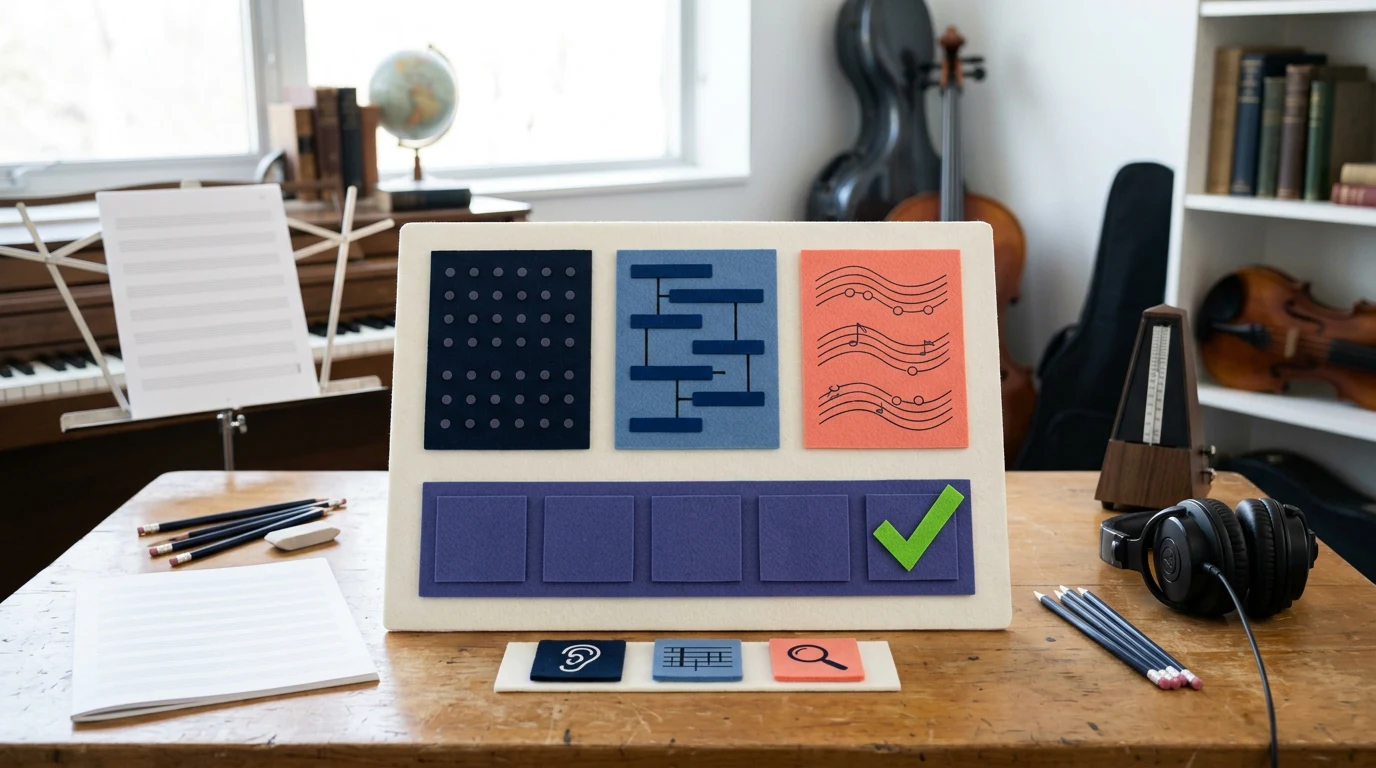
AP Music Theory is a college-level introduction to the building blocks of Western music — notation, harmony, voice leading and analysis. The exam runs about 2 hours 40 minutes: Section I is multiple choice with about 75 questions, including aural (listening) and non-aural questions; Section II is free response with written part-writing and harmonization, plus sight-singing performance tasks you record. It's scored from 1 to 5, taken in May, and many colleges grant credit for a 3 or higher — confirm your target college's policy.
Three kinds of task, one score
AP Music Theory is unusual: alongside multiple choice and written free response, you actually sing. Your score blends what you know, what you can hear, and what you can perform at sight.
~75 questions, aural & non-aural.
The aural questions ask you to answer about recorded excerpts you hear — identifying intervals, chords, errors and form. The non-aural questions test notation, terminology, scales, key signatures and analysis without sound. Together they make up Section I.
Written part-writing & harmonization.
You notate music on the staff: realizing figured bass, writing four-part harmony with correct voice leading, harmonizing a given melody, and dictation tasks where you write down music you hear. This is where part-writing rules really count.
Melodies you sing & record.
Two short melodies you see for the first time, with a brief practice window, then sing aloud while your performance is recorded for scoring. It tests pitch accuracy, rhythm and pulse — and it rewards students who have actually rehearsed singing at sight.
Practice it, skill by skill.
Reading about theory isn't the same as answering AP-style questions and learning from every miss. Start free and practice your aural skills, part-writing and analysis.
What AP Music Theory covers
- Aural skills — hearing intervals, chords, errors and form in recorded music
- Part-writing — four-part harmony, voice leading and figured bass
- Harmonization — writing harmony to fit a given melody or bass
- Analysis — keys, scales, chord function, cadences and form
- Notation & terminology — reading and writing music accurately
- Sight-singing — performing unfamiliar melodies at sight
How to study for AP Music Theory
- Do daily ear-training: intervals, chord qualities and short dictation.
- Practice sight-singing aloud — record yourself and check pitch and rhythm.
- Drill part-writing rules until clean voice leading is automatic.
- Analyze real scores: name the chords, functions, cadences and form.
- Review every miss until the concept is clear, and sit timed sets to build pace and stamina.
AP Music Theory questions
What's on the AP Music Theory exam?
How is AP Music Theory scored?
What is a good AP Music Theory score?
How hard is AP Music Theory?
When is the AP Music Theory exam?
Keep exploring AP.
One plan for your whole testing season.
PrepScore’s full practice covers the SAT, the ACT and select AP subjects — with an explanation on every question.