
See where your SAT score stands — and what to do next.
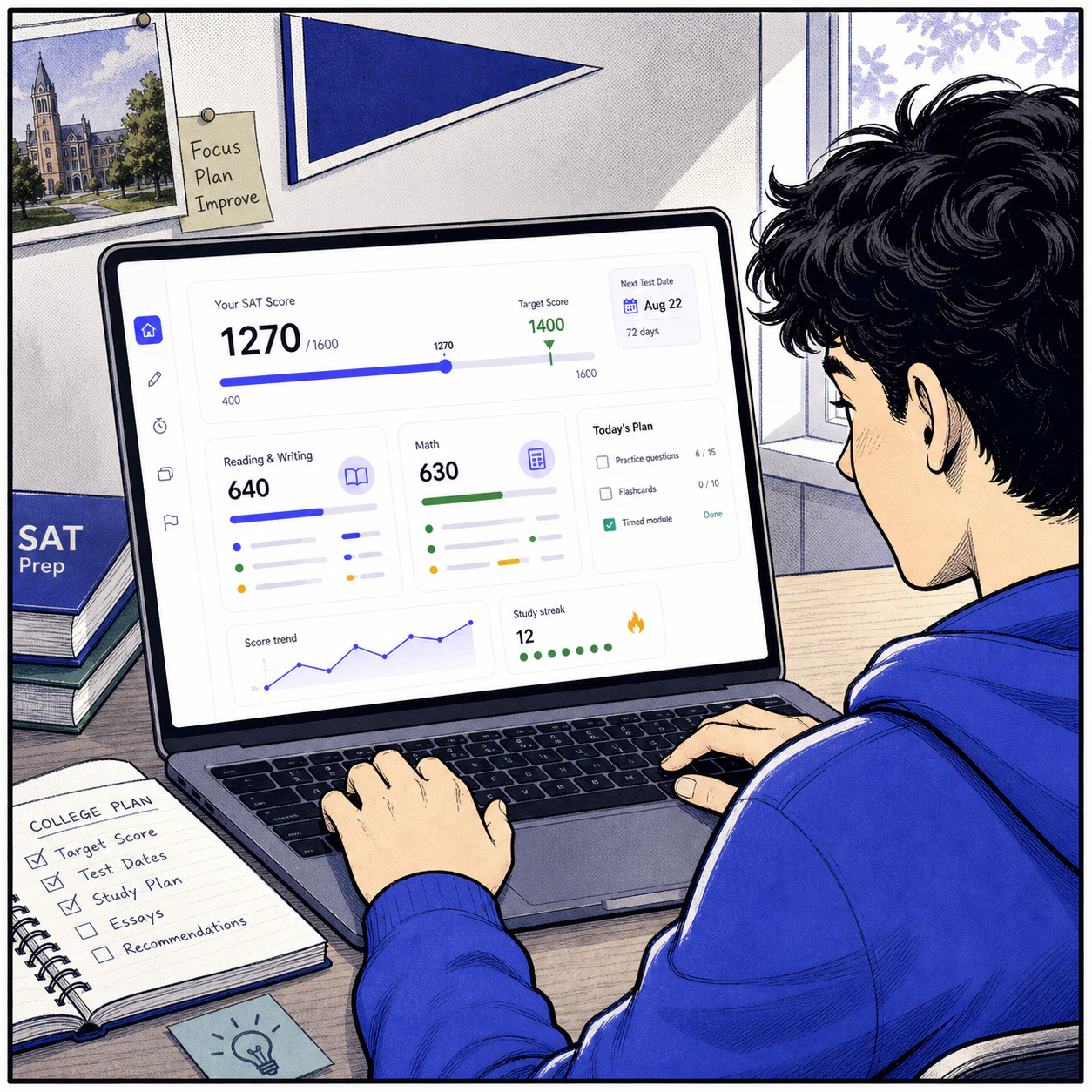
Your practice becomes one estimate toward your target score, with your weak domains across Reading & Writing and Math, study signals and today's plan. There's no pass line — just your goal.




Official practice gives you a score — not a plan.
Bluebook hands back a number and stops. The questions that actually matter are: am I on pace for my target, which domains are costing me, and where did the adaptive test take me?
One estimate, shown as a range.
Weighted like the real exam and mapped to the 400–1600 scale, against the target you set. Thin data shows "calibrating" — never a made-up score, because inflated estimates are how prep loses your trust.
It names the domain to work next.
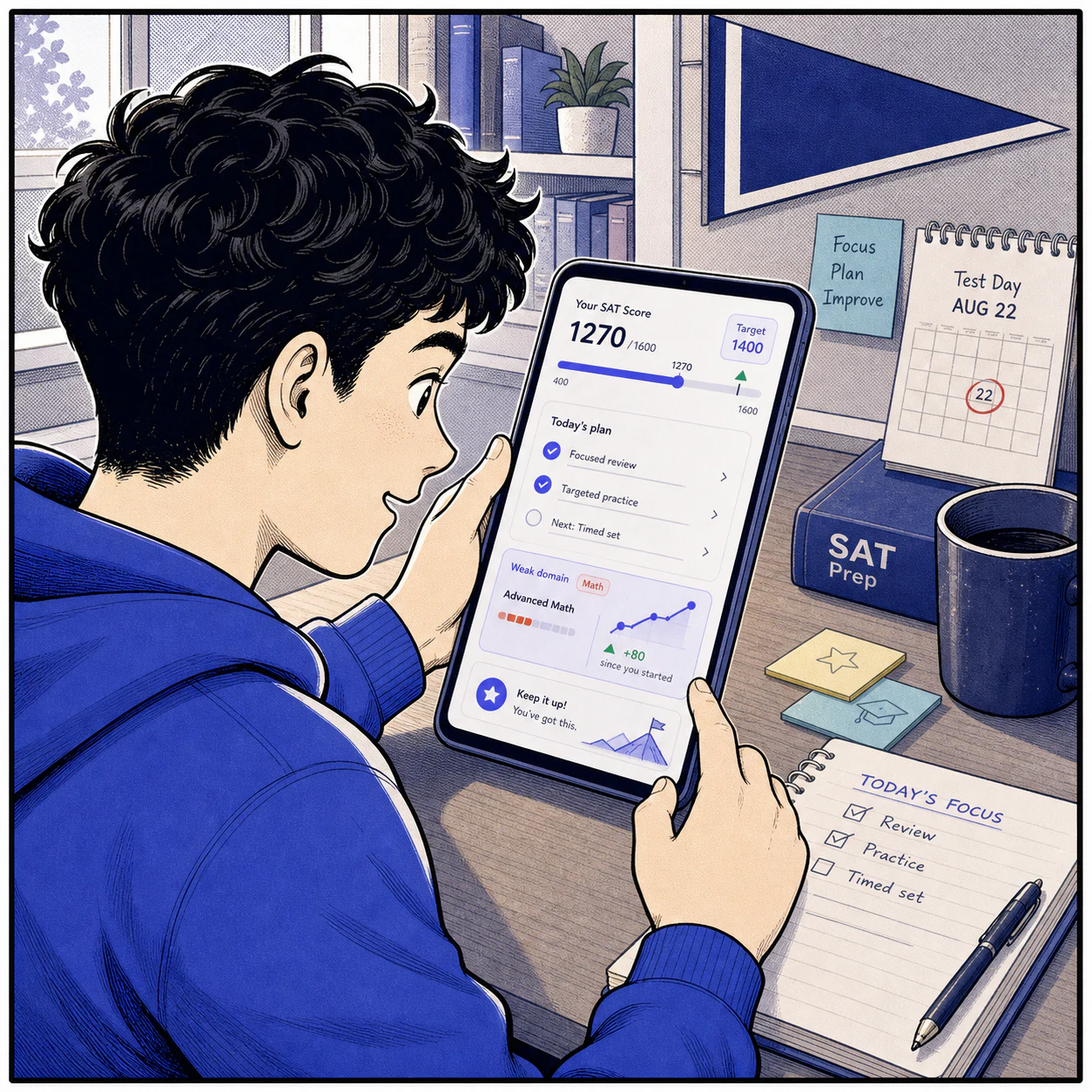
The dashboard points at the one domain across RW and Math that moves your score most right now — with a button straight into practicing it.
No streaks, no points, no pass line.
The SAT has no pass mark, so neither do we. You aim at a target score, and every number maps to a study action — not a badge.
A practice estimate, climbing toward your target.
Your accuracy in each official domain is weighted like the real exam and mapped onto the 400–1600 scale — split into your Reading & Writing and Math scores. You see the gap to your target, your percentile, and the one domain to attack next. An ⓘ shows exactly how it's calculated, with your own numbers.
- Weighted to the official SAT domains and the 400–1600 scale
- Shown as a range against the target you set — no pass line
- Names the highest-leverage domain to practice next
- Shows "calibrating" until you've answered enough — never a faked number
The same three layers as your official score report.
Total, then your two section scores, then the official domains inside each — the structure College Board uses, but with the analysis it leaves out. Each domain is colored by your accuracy, with your weakest one flagged so you know where to aim.
Reading & Writing
Math
The habits a single score hides.
Six tiles, each answering a real question about whether you're ready — and each pointing at what to do about it.
It opens on what to do today.
The top carries your countdown to an official test date; below it, a short plan for today — some practice, your due cards, and one timed module (the SAT's natural timed unit). The plan is sized from your target and your date, not a fixed quota.
- Countdown to a real College Board test date you pick
- Three focused tasks, planned backward from your goal
- Resets each day — no backlog, no streak guilt
Reads from, points to
Useful for searches like
- SAT score estimator / predictor
- Am I on track for my SAT target
- SAT progress tracker by domain
- SAT readiness dashboard
SAT dashboard questions
What does the practice estimate mean?
Is there a pass line on the SAT?
What is the Module 2 route signal?
How is this different from official practice?
Stop guessing where your SAT score stands.
Start free — answer a few questions and the dashboard starts reading where you are.